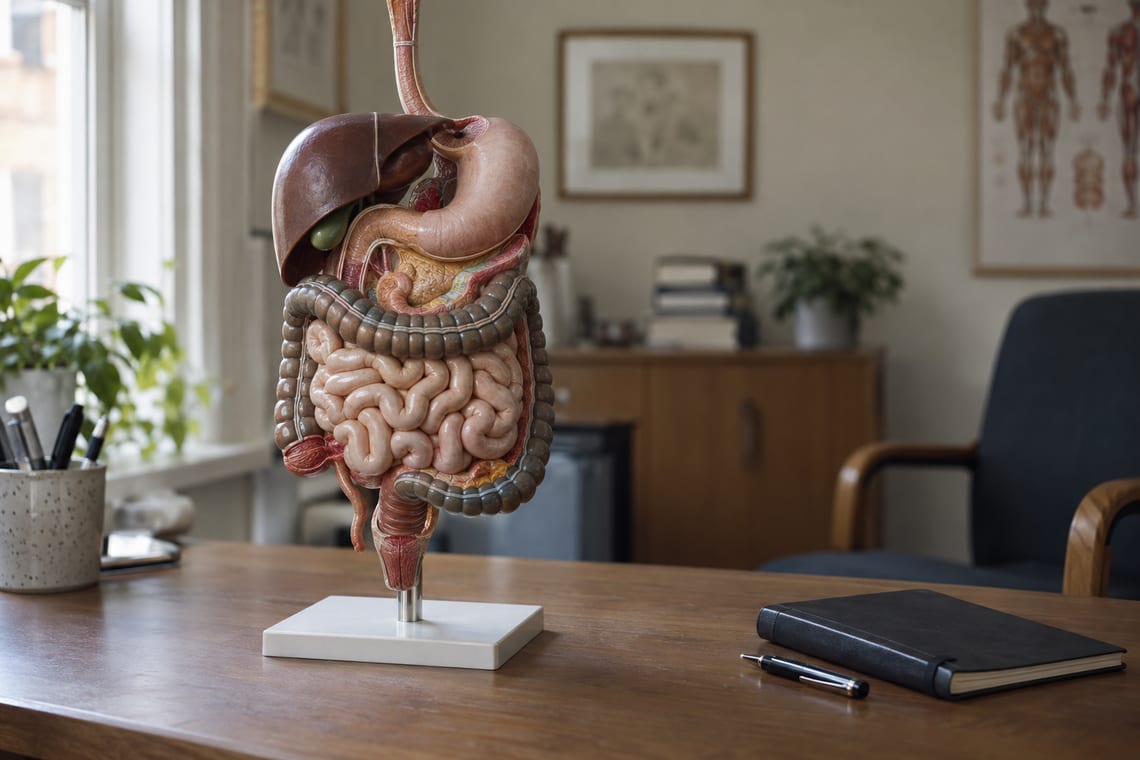

Ulcerative colitis has a more distinctive opening than most gut conditions, and that is largely down to where it starts. Inflammation begins at the rectum, the very last stretch of the bowel, and spreads upwards in a continuous band. Because the rectum is the part of the gut that tells you when to go, the earliest symptoms are about urgency and blood rather than vague discomfort.
That makes the pattern recognisable — if you know what you are looking at.
The four earliest and most common signs
1. Diarrhoea with blood or mucus
This is what most people notice first. The blood is usually mixed through the stool rather than sitting on top of it, and there is often clear or yellowish mucus alongside. The stool itself may be loose, or it may be small and frequent rather than genuinely watery.
The distinguishing feature is not severity but persistence. A gut infection clears within days; colitis does not. Bloody diarrhoea lasting more than four weeks, or returning in episodes over several months, is the clearest early signal there is.
2. Urgency, and that unfinished feeling
Inflamed rectal lining loses its ability to hold stool and to judge how much is there. Two things follow. The first is urgency: needing a toilet within a minute or two rather than being able to wait. The second is tenesmus — a constant feeling of needing to go, with a lot of straining and very little result, sometimes passing only blood and mucus.
Tenesmus is one of the more specific early signs, and it is the one people are most reluctant to describe. It is worth describing anyway.
3. Cramping pain, often low on the left
Because ulcerative colitis works upwards from the rectum, pain tends to sit low down and on the left, where the descending colon runs. It is typically crampy rather than constant, often builds before needing the toilet, and eases briefly afterwards.
If the inflammation extends further around the colon, the pain spreads with it. Limited disease — proctitis, affecting the rectum alone — may cause very little pain at all, just bleeding and urgency.
4. Fatigue that rest does not fix
This is the symptom people most often leave out of the conversation with their GP, and one of the most useful. It comes from the inflammation itself, from blood loss causing iron deficiency, and from nights broken by needing the toilet. The hallmark is that it is disproportionate — tiredness that does not match what you have actually been doing.
Less obvious early signs
Ulcerative colitis is an immune condition affecting the whole body, not just the bowel, and the first thing you notice is not always digestive:
- Unintended weight loss, usually less pronounced than in Crohn’s because the small intestine still absorbs normally
- A low-grade fever during flares
- Joint pain and stiffness, particularly in the knees, ankles and lower back
- Sore, red or light-sensitive eyes — episcleritis or uveitis
- Tender red lumps on the shins, a skin reaction called erythema nodosum
- Painful skin ulcers, most often on the legs, called pyoderma gangrenosum
- Mouth ulcers, less common than in Crohn’s but not rare
- Itching, pale stools or yellowing of the eyes, which can point to primary sclerosing cholangitis — a liver condition much more closely associated with ulcerative colitis than with Crohn’s
In children, slowed growth may appear before the bowel symptoms become obvious.
When to see a doctor without waiting
Book a routine GP appointment if you have had diarrhoea, rectal bleeding or both for more than four weeks.
Seek help the same day if you have:
| Sign | Why it matters |
|---|---|
| Six or more bloody stools a day | The threshold for acute severe colitis |
| Fever, or a heart rate over 90 at rest | Systemic signs of severe inflammation |
| Severe, constant or spreading abdominal pain | Can signal complications in the colon wall |
| A swollen, tender, drum-tight abdomen | May indicate toxic megacolon, which is an emergency |
| Dizziness, breathlessness or marked pallor | Suggests significant blood loss |
Acute severe ulcerative colitis affects a meaningful minority of people at some point and is treated in hospital. It responds well to prompt treatment and badly to being waited out, which is why that list matters.
The test to ask for
If your GP is weighing up irritable bowel syndrome against inflammatory bowel disease, the most useful first step is a faecal calprotectin test — a stool sample measuring a protein released when the bowel lining is inflamed.
It does not diagnose colitis by itself, but it does something valuable: it separates inflammatory conditions from functional ones. A normal result makes IBD unlikely. A raised result is the trigger for referral.
Expect it alongside:
- Stool culture, to rule out an infection that would explain everything
- Blood tests for anaemia, ferritin, CRP and platelets
- Flexible sigmoidoscopy or colonoscopy with biopsies, which is what actually confirms the diagnosis and shows how far up the colon the inflammation reaches
NICE recommends calprotectin specifically to help distinguish IBD from IBS in adults with recent lower gastrointestinal symptoms, so it is reasonable to ask for it by name.
Why how far it extends matters
Once diagnosed, you will be told the extent of your colitis, and it shapes almost everything that follows:
- Proctitis — the rectum only. Often managed well with suppositories or enemas alone.
- Left-sided colitis — up as far as the bend below the ribs on the left.
- Extensive colitis or pancolitis — most or all of the colon. More likely to need systemic treatment, and the group for whom bowel cancer surveillance from around eight to ten years after diagnosis is most important.
Extent can change over time in either direction, which is why a repeat colonoscopy is sometimes suggested years later even when things are going well.
What happens next
An ulcerative colitis diagnosis is not what it was a generation ago. Most people reach remission and stay there on maintenance treatment, and the great majority live full working and family lives. The point of recognising the early pattern is to start treatment while the inflammation is still just inflammation.
A note on self-diagnosis. None of these signs are unique to ulcerative colitis on their own. Bloody diarrhoea, urgency and fatigue have several causes, and infection is a more common explanation than colitis. The purpose of knowing the pattern is to have a more specific conversation with your GP — not to reach a conclusion without one.