Two things are true at once about diet and ulcerative colitis, and most of the confusion online comes from picking only one of them.
The first: no food causes ulcerative colitis and no diet cures it. The condition is an immune reaction in genetically susceptible people, and that is not something a shopping list can undo.
The second: what you eat makes a real difference to how you feel and may influence how often you flare. Your colon is fed largely by what your bacteria do with your food, so diet is not a side issue.
Holding both at once gets you to a sensible place: diet as a genuine lever, not a cure.
The flare list and the remission list are different
This is the single most useful distinction in colitis nutrition, and it is the one most commonly missed.
In a flare, your colon lining is inflamed and ulcerated. The aim is to reduce what passes over it, keep up calories and fluid, and not make urgency worse. Restriction is appropriate, and temporary.
In remission, the aim is the opposite: eat as broad a diet as you tolerate, feed your microbiome well, and avoid the nutritional deficiencies that come from years of unnecessary elimination. Staying on a flare diet during remission is one of the commonest self-inflicted problems in IBD.
What to avoid during a flare
Insoluble fibre
The most frequently reported trigger. Insoluble fibre adds bulk and passes through largely intact, which is uncomfortable over inflamed, ulcerated lining.
In practice that means avoiding, for a few weeks:
- Skins, pips and seeds — apple and pear peel, tomato skins, berry seeds, sweetcorn
- Nuts and whole seeds
- Raw vegetables and salad
- Wholegrain bread, brown rice, bran cereals
- Pulses, beans, lentils and chickpeas
- Dried fruit
Soluble fibre is different and usually well tolerated: oats, peeled and cooked apple, banana, white rice, peeled potato, well-cooked carrot. It dissolves into a gel, which can genuinely help loose stools.
Alcohol, caffeine and spice
All three speed up gut transit and irritate the lining. Caffeine is a direct stimulant of colonic movement, which is the last thing you want when urgency is the main problem. Alcohol worsens dehydration at a point when blood and fluid loss are already an issue.
Lactose, if you are intolerant
Lactose intolerance affects a significant share of the population regardless of colitis, and its symptoms — bloating, cramps, loose stools — are easily mistaken for a flare. Test it properly with lactose-free alternatives for a fortnight rather than abandoning dairy.
Sugar alcohols and artificial sweeteners
Sorbitol, mannitol, xylitol and maltitol — in sugar-free gum, mints, diabetic products and some medicines — draw water into the bowel and are poorly absorbed. They cause diarrhoea in people with perfectly healthy guts.
Very fatty and fried food
Fat slows stomach emptying and, in larger amounts, can worsen diarrhoea. Smaller, more frequent meals are generally easier than two or three large ones.
What to limit in remission
This is a shorter and more evidence-led list.
Ultra-processed food, particularly emulsifiers
The mechanism here is specific to colitis and worth understanding. The lining of your colon is protected by a thick mucus blanket. Emulsifiers — polysorbate-80, carboxymethylcellulose, carrageenan — are added to processed food to keep ingredients from separating, and in laboratory and animal studies they thin that mucus layer and shift the microbiome towards inflammation. Human feeding trials have shown measurable microbiome effects.
This is not proof they cause flares in people. It is a credible mechanism in the right tissue, and reducing ultra-processed food is sound advice for other reasons anyway. Read labels on ice cream, processed bread and bakery goods, sauces, dressings, flavoured yoghurts and meat alternatives.
Red and processed meat, in quantity
Evidence linking high red and processed meat intake to relapse is stronger in ulcerative colitis than in Crohn’s. The proposed route is sulphur metabolism: sulphur-rich protein feeds bacteria that produce hydrogen sulphide, which blocks colon cells from using butyrate — exactly the fuel they rely on.
Moderation, not elimination. Oily fish, poultry, eggs and plant protein are reasonable substitutes.
Added sugar and refined carbohydrate
Associated in cohort studies with higher IBD incidence and with less favourable microbiome profiles. The effect size is modest and the evidence is observational, but the direction is consistent.
What the evidence supports eating
| Pattern | What it is | Evidence |
|---|---|---|
| Mediterranean diet | Vegetables, fruit, olive oil, oily fish, pulses, wholegrains, little processed food | The best-supported overall pattern for IBD; associated with lower disease activity and better quality of life |
| Oily fish, twice weekly | Salmon, mackerel, sardines | Long-chain omega-3s; anti-inflammatory rationale, modest trial evidence |
| Fermentable fibre, in remission | Oats, cooked vegetables, pulses reintroduced slowly | Feeds butyrate-producing bacteria, the colon’s main fuel source |
| Adequate vitamin D | Supplement in UK winter | Low levels associated with higher disease activity |
The UK Chief Medical Officers recommend a vitamin D supplement for everyone through autumn and winter; it is particularly worth attending to with IBD.
Finding your own triggers without wrecking your diet
Trigger foods are genuinely individual, and the biggest mistake is cutting out a long list at once based on what you read.
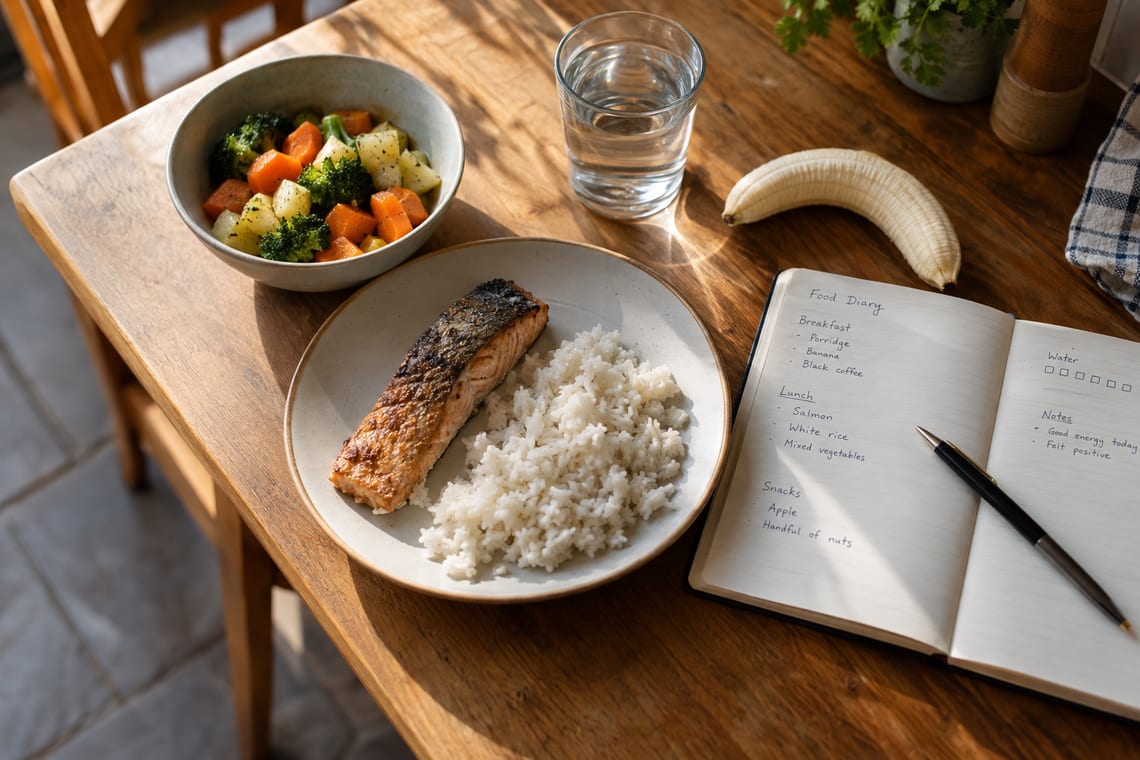
- Keep a diary for two weeks. Food, timing, symptoms, stress, sleep, medication. Two weeks, honestly recorded, beats any amount of guessing.
- Look for repeats, not single incidents. A bad day after a curry proves nothing. Three bad days after three curries is a pattern.
- Test one food at a time. Remove it for two weeks, reintroduce it deliberately, watch what happens. If nothing happens, it was not the problem — put it back.
- Get a dietitian involved if your list is growing. IBD dietitians exist precisely for this, and a referral is reasonable to ask for.
- Separate flare symptoms from food reactions. Rising inflammation makes everything feel like a trigger. Check whether the diary tracks your disease activity rather than your meals.
One caution on elimination diets. Restrictive protocols — specific carbohydrate, low-FODMAP long term, carnivore, extended fasting — are easy to find and are often presented as cures. Low-FODMAP has decent short-term evidence for symptom relief in IBD, but it is a diagnostic tool for a few weeks, not a permanent diet, and it starves exactly the bacteria your colon depends on. None of these approaches has been shown to control inflammation. If you are considering one, do it with a dietitian and keep taking your medication.
The practical version
During a flare: low-residue, small frequent meals, plenty of fluid, soluble fibre over insoluble, skip alcohol and caffeine, peel and cook everything. Tell your IBD team — a flare needs treating, not just eating around.
In remission: eat broadly, cook from scratch where you can, oily fish twice a week, plenty of cooked vegetables and fruit, go easy on ultra-processed food and large servings of red meat, take vitamin D in winter, and keep taking your maintenance medication.
Nothing on that list is exotic. That is rather the point.